Signing your child up for sports should feel exciting but can often leave parents feeling overwhelmed.
It can be hard to know what actually matters. Not all programs are built the same and the right fit has less to do with the logo on the jersey and more to do with what’s happening behind the scenes.
Whether you’re a parent exploring entry-level sports programs for the first time or a seasoned pro trying to determine the next step on your child’s sports journey, start here:
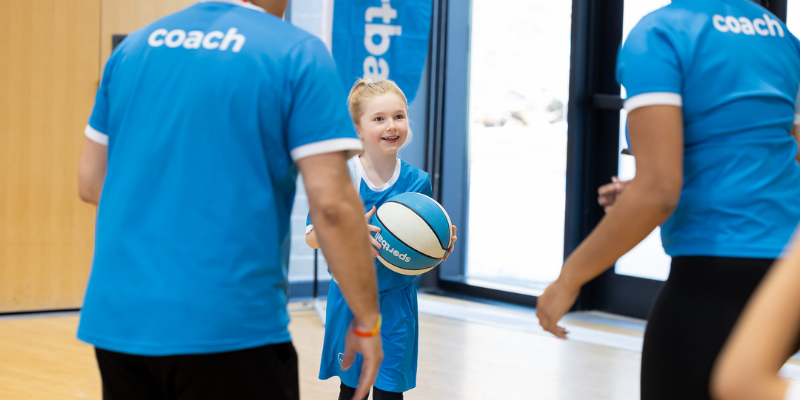
1. Who is actually coaching my child?
Not all coaches are created equal, and for young kids, this matters more than most parents realize.
Research shows that coach quality is one of the strongest predictors of a child’s long-term enjoyment and retention in sport.
Ask:
- What certifications do coaches hold?
- Are they trained in child development, or just the sport itself?
- Do they receive ongoing education?
- Are they coaching with purpose?
A purposeful coach positively shapes a child’s relationship with physical activity for years to come.
2. Is this program developmentally appropriate?
It’s easy to focus on what kids are learning instead of how they’re learning it.
Children develop physically, cognitively, and emotionally at different rates. A 4-year old and a 10-year old differ in attention span, coordination, how they process feedback, and more.
High-quality programs are designed to meet children where they are at developmentally.
Ask:
- Is the curriculum age-specific?
- Are sessions intentionally structured to develop social, behavioural, gross motor and sport-specific skills?
- What is the balance between structured learning and free play?
- Is the time commitment equivalent or less than a child’s age?
3. What are the goals of the program and where does fun fit in?
Some programs are focused on competition. Others on drills and sport-specific skills. The best programs? They intentionally use the power of fun to instill life lessons and promote physical literacy. Skill building should cater to the developmental stages of young athletes.
We know:
- Kids who have fun stay in sports longer
- Kids who stay in sports longer develop a lifelong love of movement, are more confident, have better mental and physical health, and are more likely to hold leadership positions
Ask:
- Is fun integral to the program design?
- How is success measured?
- Is the focus on winning, improvement, or experience?
4. Does this actually work for our family?
A great program on paper doesn’t mean much if it doesn’t fit your real life.
Between school, work, and the juggle of life with kids, sustainability matters. Burnout doesn’t just happen to kids—it happens to families too.
Ask:
- Does the schedule align with our weekly routine?
- What are the total costs (not just registration)? Ex. Equipment, uniforms, tournaments, travel, etc.
- Are there travel or time commitments we’re not seeing upfront?
- Is equipment provided or will we need to bring our own?
Multi-sport programs like Sportball that run once a week and provide all the necessary equipment are a great option for busy families.
Research on youth sport participation shows that cost and time are among the top reasons families drop out of programs.
5. What does progression actually look like?
Too many programs leave parents guessing about how (or if) their child will improve over time.
The right program has a clear progression pathway from fundamentals to game play.
Ask:
- Is there a defined development plan?
- How are skills assessed or tracked?
- What happens after this season ends?
- What does specific program progression look like?
6. What does this program do to keep my child safe?
Youth sports injuries are common in programs that emphasize sport specialization, drills, and game play using adult sized equipment and class plans. You’ll want to find a program designed to prevent overuse or sport related injuries. On top of program integrity, you’ll want a coach you can trust is prepared for any scenario.
Ask:
- Are coaches trained in first aid?
- Have coaches been vetted through background checks?
- Is the equipment age-appropriate and well-maintained?
- What do drop-off and pick-up procedures look like?
- Is there a clear code of conduct?
- What are other parents saying about this program/coach?
A program that takes safety seriously will be transparent about it. If the answers are vague or buried somewhere, that’s information too.
7. How big are the teams, and what’s the coach-to-child ratio?
Group size shapes how much individual attention, repetition, and feedback your child actually gets in a season.
Ask:
- How many children are typically in a session?
- What is the coach-to-child ratio?
- What is the policy with respect to playing time for each child?
8. What happens when my child has a tough day?
Every child has off days or needs a little bit of time to warm up to something new. How a coach handles those moments will be important to your child’s experience with sport.
Ask:
- How do coaches respond when a child is reluctant to participate?
- How are big emotions handled by coaches?
- How do coaches communicate with parents about a child’s behaviour?
- How do coaches approach children with exceptionalities?
A great sports program will use those moments as an opportunity to build confidence.
9. Can we try before committing?
Sports programs are an investment. An opportunity to try the program before you commit will let you experience firsthand if it’s a fit.
Ask:
- Is there a trial or intro class available?
- What’s the refund, transfer, or make-up policy if something doesn’t work out?
- Can we drop in and observe a session before signing up?
- How can I prepare my child for a successful season?
Sportball offers trial classes so families can see the magic in action before enrolling. Flexibility here is a sign that a program is prioritizing the child’s experience, and wants you to feel like it’s the right choice, too.
10. What does my child want?
It’s easy to forget that an important voice in this decision belongs to the kid you’re signing up.
Ask your child:
- What sports or activities are you curious about?
- Do you want to try something new, or stick with what you already know?
- Do you want to play with friends, or meet new ones?
- How do you feel after practices and games?
Their answer doesn’t have to be the deciding factor; you’re still the grown up. But asking sends a powerful message: this is something we’re doing because it’s fun for you.
Choose your sports program with intention
Research is clear: young children shouldn’t play organized, competitive sports. They should be learning through play, exploration, and fundamental movement skills in a fun and supportive environment. Look for programs that put these research-based guidelines for youth sports into practice:
- Designing programs around children’s developmental needs
- Multi-sport exposure
- Age-appropriate skill progressions
- Purposeful coaches trained in child development
- First-aid certified coaches and additional safety measures in place
- A focus on fun first, skills second, competition much later
When asking yourself the right questions before committing your little athlete to a sports program, you’re setting them up for success both on and off the field.
Resources
Luo, Y., et al. (2025). The predictive role of coach–athlete relationship quality in training engagement and performance. Frontiers in Psychology. https://pmc.ncbi.nlm.nih.gov/articles/PMC12426250/
Sportball. (n.d.). When should kids start sports? https://sportball.com/blog/when-should-kids-start-sports/
American Academy of Pediatrics. (2022). Organized sports for children, preadolescents, and adolescents. https://ncys.org/wp-content/uploads/2022/10/Organized-Sports-for-Youth_AAP-Clinical-Report.pdf
Sportball. (n.d.). The importance of childhood free play. https://sportball.com/blog/the-importance-of-childhood-free-play/
Sportball. (n.d.). Multi-sport for kids: A complete guide. https://sportball.com/blog/multi-sport-for-kids-guide/
Sportball. (n.d.). Programs. https://sportball.com/programs/
Eime, R. M., et al. (2019). A systematic review of the psychological and social benefits of participation in sport for children and adolescents. International Journal of Environmental Research and Public Health. https://pmc.ncbi.nlm.nih.gov/articles/PMC6805064