If we were to ask any young child if they’d rather “kick a ball” or “launch a rocket into outer space using their foot“, we can almost guarantee they would choose rocket launching any day of the week. We know this because kids are born filled with curiosity, innocence and wonder, and storytelling can be a powerful teaching tool for tapping into their imaginations.
At Sportball, we infuse storytelling into everything that we do, which not only makes our classes effective, but more fun too! Here’s why we think storytelling is such a powerful teaching tool for kids.
Stories Hook Kids’ Attention
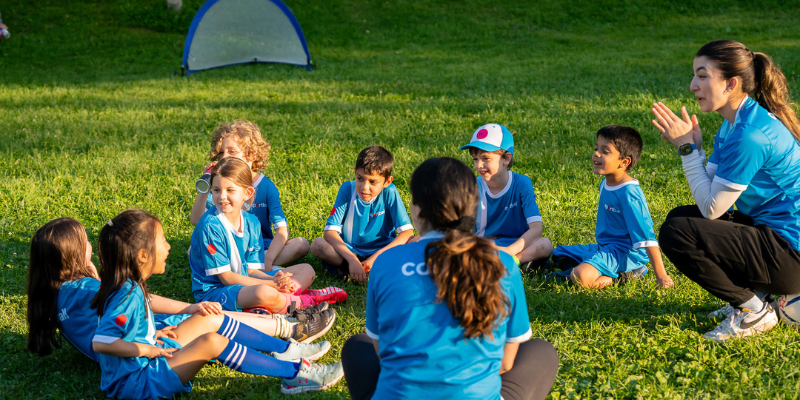
Stories help us capture children’s attention and keep them engaged. This enables our coaches to maintain focus on skill development throughout the duration of class and prevents kids from becoming distracted or disengaged.
Today’s kids are surrounded by fast, flashy screens—and studies from groups like the AAP and Johns Hopkins show that this kind of overstimulation can crowd out the slower, creative play their brains actually need. Somewhere along the way, storytelling got pushed aside by shows and apps doing all the imagining for them. When we bring storytelling back into kids’ activities, we’re giving them a calm, engaging space where their own ideas take the lead—and that’s where the real magic (and learning) happens.
It’s amazing to see how kids perk up and focus in when they’re trying to wake a sleeping dinosaur or get a dodo bird egg out of Tweetie’s nest instead of simply trying to spike a volleyball or work on their underhand serve.
Stories Help Us Speak Kids’ Language
Stories help us bridge the communication barrier between adults and kids. Have you ever tried to teach your child a new skill or ask them to follow specific instructions, only to have them stare back at you blankly, do the complete opposite of what you asked or just turn on their little heels and walk away? (That last one gets us every time!) It’s easy to forget sometimes that kids aren’t just little adults and that their communication skills, comprehension of language, emotional regulation and understanding of the world are all still very much developing.
Research shows that storytelling isn’t just about reading books—it’s the full mix of oral stories, pretend play, acting out characters, and using movement to bring narratives to life. Studies from 2022–2024 show that these forms of storytelling boost phonics skills, vocabulary, expressive language, and even the development of inner “self-talk,” which helps kids learn to plan, reflect, and communicate actively. When your child becomes a dinosaur, hops like a bunny, or shouts “OH NO!” at the exciting part—they’re not interrupting the story. They’re learning from it. ****
And storytelling isn’t just for learning—it also helps kids understand safety in a way that feels fun rather than restrictive. For example, when we ask children to pretend their hockey sticks are “tails” they must tuck carefully behind them on the way back to the Magic line, they instantly stop waving them around because they’re focused on staying in character and keeping the story alive.
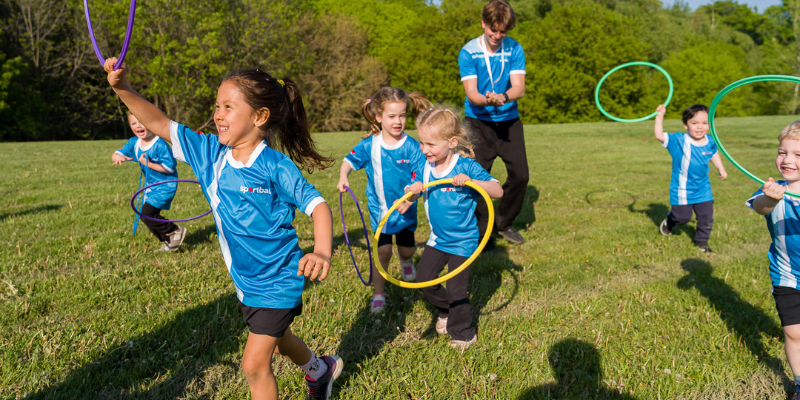
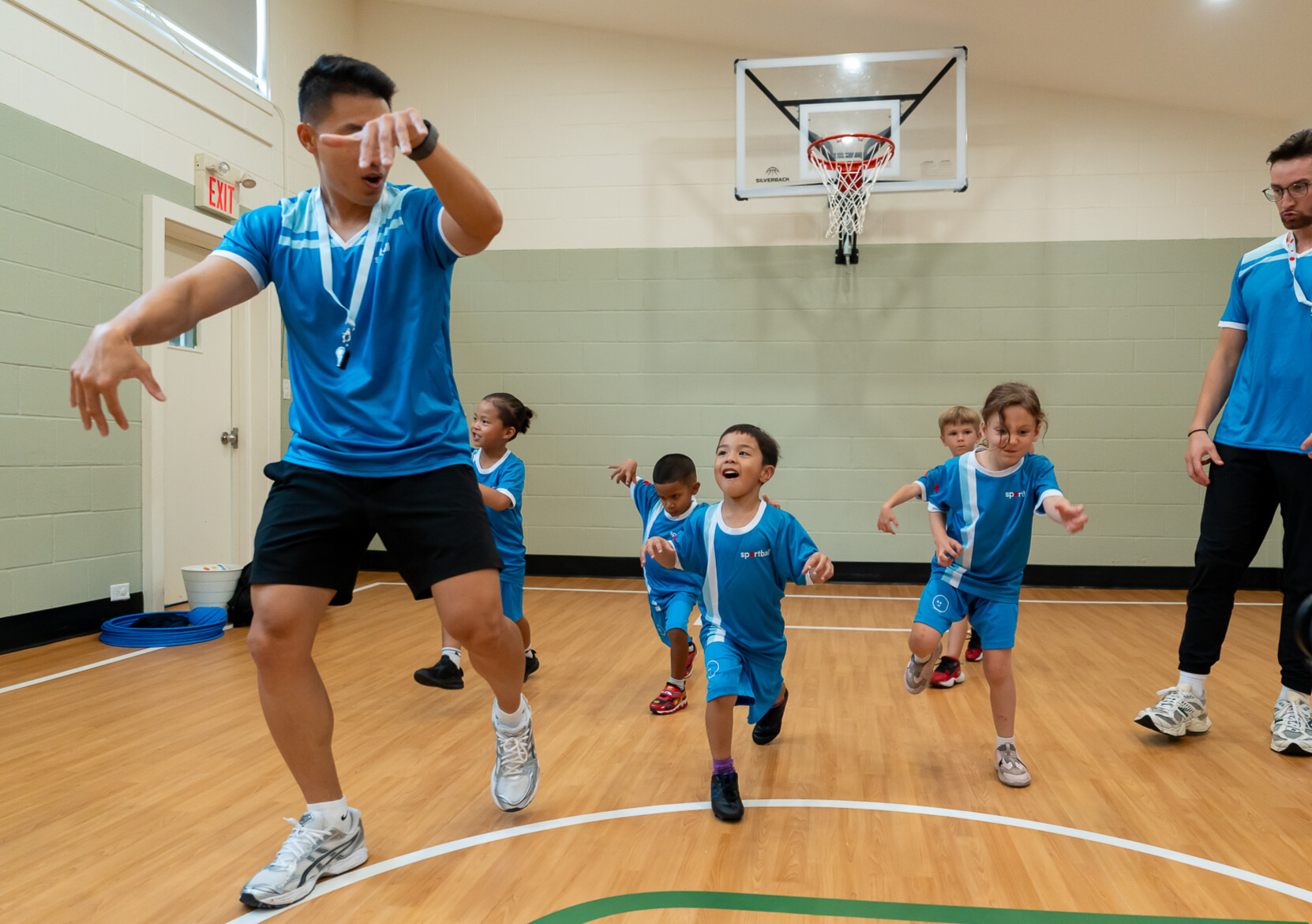
At Sportball, we know that children learn through play – it’s like a child’s language, which is why we don’t just shoot a basketball, we feed hamburgers to hungry hippos! When children tell stories with their voices and their bodies, they strengthen the exact systems needed for confident reading and expressive language.
Stories Stick in Kids’ Minds
Stories help kids hardcode information into memory. Regardless of age, our imaginations can easily be captured by an incredible story, and it has been scientifically proven that we are more likely to remember things in the form of a well-told story when compared to facts and figures alone (Boris, 2025).
When kids at Sportball act out stories, they’re building mental “story‑maps” or schemas that stick. Research shows that early storytelling and pretend play help children form richer, more flexible mental structures for understanding themselves, other people and the world around them. For example, a study found that when toddlers were given a simple story prompt, they engaged in more and richer pretend play — which supports imagination, emotional expression and symbolic thinking.
The ability to tap into the imagination is even more powerful and important for kids whose unbound sense of wonder is fleeting. By using stories to teach age-appropriate physical, social and emotional skills to young children, we can build a foundation that will stick with them for a lifetime.
The Magic Ingredient: Fun!
Last, but definitely not least, stories are just more fun! When things are fun, kids want to participate, learn and stay active. Play-based storytelling isn’t just entertainment—it actually helps children develop important skills while keeping them fully engaged. Pretend and free play, like acting out a story or moving as different characters, boosts imagination, social skills, and problem-solving abilities (Bredikyte et al., 2023).
Kids who get to explore, act, and invent stories with their bodies and voices aren’t just having a blast—they’re practicing teamwork, creativity, and even early literacy skills in ways that feel effortless. The best part? When fun and learning happen together, children build positive memories and associations with being active and learning new skills, which keeps them coming back for more.
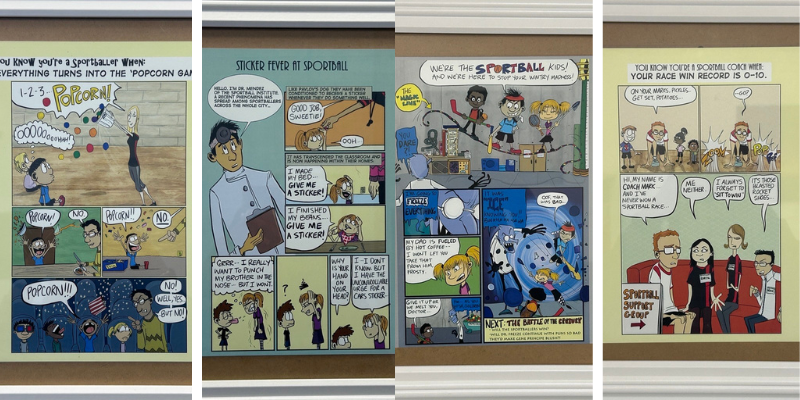
Speaking of positive memories, check out some of the incredible artwork of our iconic Sportball stories displayed in our head office, illustrated by Master Coach Tad Martindale in Edmonton, Canada.
References
American Academy of Pediatrics. (2023). Where we stand: Screen time. HealthyChildren.org. https://www.healthychildren.org/English/family-life/Media/Pages/Where-We-Stand-TV-Viewing-Time.aspx
Boris, V. (2025, June 6). What makes storytelling so effective for learning? Harvard Business Impact. https://www.harvardbusiness.org/insight/what-makes-storytelling-so-effective-for-learning/
Bredikyte, M., Smith, P., & Jones, L. (2023). Pretend play as a pathway to self-regulation: Observational and intervention evidence. Early Childhood Research Quarterly, 62, 123–135. https://doi.org/10.1016/j.ecresq.2023.02.004
Dicataldo, R., Rose, S. A., & Feldman, R. (2022). Gesture, joint engagement, and language development in early childhood. Developmental Science, 25(5), e13251. https://doi.org/10.1111/desc.13251
Granato, P., Rodrigues, J. A., & Nunes, L. R. (2022). Embodied storytelling and its effects on memory and language in early childhood. Early Childhood Education Journal, 50(6), 1043–1054. https://doi.org/10.1007/s10643-021-01248-0 ****
Jiménez, J. E., O’Shanahan, I., & Rodríguez, C. (2024). Story-based phonological awareness interventions in early childhood education. Reading and Writing, 37(2), 211–234. https://doi.org/10.1007/s11145-023-10440-4
Johns Hopkins Medicine. (2023). Television and children. https://www.hopkinsmedicine.org/health/wellness-and-prevention/television-and-children
Madigan, S., Racine, N., Tough, S., & Plamondon, A. (2024). Contexts of screen use and associations with developmental outcomes in early childhood: A systematic review. JAMA Pediatrics, 178(2), 192–201. https://doi.org/10.1001/jamapediatrics.2023.5376
Takagi, Y., Tsuboi, S., Watanabe, T., Oka, Y., Kojima, R., Ando, M., Kanehara, A., Kawaida, K., Jinzaki, M., & Yamagata, Z. (2023). Association of screen time use at age 2 years with neurodevelopmental outcomes at 4 years of age. JAMA Pediatrics, 177(5), 478–486. https://doi.org/10.1001/jamapediatrics.2022.6623
Weiss, S. J., Suskind, D. L., & Levine, S. C. (2022). Parent–child talk and emergent literacy: A systematic review. Journal of Child Language, 49(4), 823–856. https://doi.org/10.1017/S0305000921000560
Ronda Robinson is the Product Team Lead and a Mentor Coach at Sportball for the last 4 years. She is a recent graduate with a Master of Arts in Child Study and Education from University of Toronto. Ronda has a passion for designing curriculum and writing on childhood resilience.