Thank you so much for doing this with us! Before we dig in, our readers would like to ‘get to know you’. Can you tell us a bit about your background and your backstory?
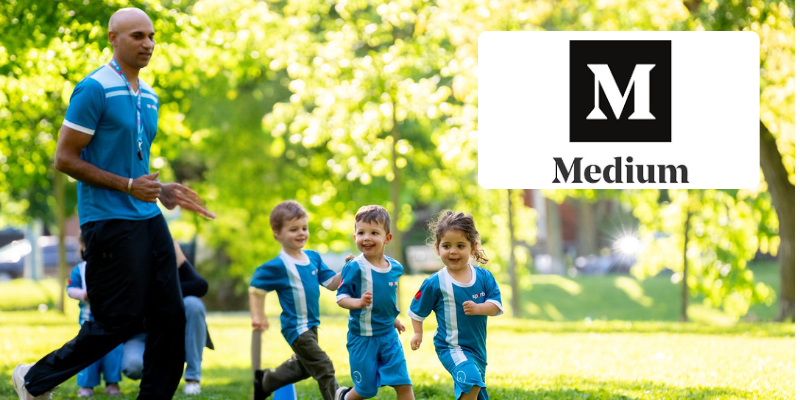
I grew up loving sports, playing basketball and looking up to my favorite players. The thought of building a career around playing sports felt like a dream, but after studying psychology and sports methodology, I was able to turn my skill set and expertise into a career that helps build the next generation of kids who love to play. I’ve spent the last 20 years of my life as part of the Sportball family, first as a coach of their youth sports programs and now as Vice President and Growth Coach, and I’ve been able to help shape the curriculum into what it is today.
Can you share a story with us about what brought you to your particular career path?
My career path really came together at the intersection of two lifelong passions: sports and working with kids. Growing up, I always wanted to play sports professionally, but after coaching from a young age and studying to become a child psychologist, I realized what I truly loved was helping children grow. I worked with a family whose child had additional needs, and that experience got me deeply interested in cognitive behavioral therapy and supporting children with exceptionalities. When I discovered Sportball, it felt like the perfect combination of my areas of excellence: sports and child development, with a focus on positivity. I was hired initially as a coach, and knowing my background in psychology, the founders asked me to design a program for children with special needs. My experience quickly evolved into a career where I could shape programs, mentor young coaches and help thousands of children build confidence and resilience through sports.
Can you share with our readers a bit about why you are an authority on raising resilient kids? In your opinion, what is your unique contribution to this field?
My career has been all about helping kids develop a love of physical activity, while developing vital life skills at the same time. I spent four years as a Sportball coach then led our training and adapted programs, where I helped integrate child development theory with sport-specific skill progression. Our focus has never been on training the next generation of pro athletes. It’s about helping kids of all skill levels find the fun in physical activity and play, while building confidence, resilience and social skills that will carry them through adulthood.
Do you have a favorite “Life Lesson Quote”? Do you have a story about how that was relevant in your life or your work?
One quote that has always stayed with me is: “Children are the living messages we send to a time we will not see.” When I came across it midway through my career, it reminded me that it doesn’t matter if a kid grows up to be a great athlete, if they’re not a good human being. Every interaction with kids matters, and whether you’re a parent, teacher or coach, you’re constantly a role model. This quote helps me be a better dad, coach and trainer of young professionals. A moment that really brought it to life was a child in an adaptive program who struggled with a skill and wanted to quit. He had oppositional defiant disorder and didn’t connect well with coaches and teachers. Instead of pushing him to perform, I focused on building trust and connection with kindness. It took several weeks, but eventually, he not only wanted to come to Sportball, but he began supporting other kids who were struggling. That moment reminded me that when we invest in a child’s character and confidence, the ripple effects can be far greater than we ever expect.
Ok, thank you for all that. Now let’s move to the main focus of our interview. How can parents handle situations when a child faces failure or disappointment? What strategies can parents use to help a child bounce back?
The first step is normalizing failure as part of learning. Too often we rush to fix the problem or shield them from disappointment, but those moments are actually where growth happens. With my own daughters, I’ve learned to validate their emotions first and make sure they feel heard — not just give solutions. When they come to me with a problem, I’ll even ask if they want me to help fix it or just be there to listen to them. From there, parents can ask simple, reflexive questions, like “What did you learn?” or “What would you try next time?” It’s also important to celebrate the effort vs. the outcome. Focus more on the character development than the trophy. Keep the moment small and make sure your child sees that you’re composed and can be that rock for them to learn from.
What role does parental modeling of resilience play in the development of emotional strength in children? Can you share an example of a resilient parenting moment that you experienced directly or that you have come across in the course of your work?
I often say that kids either borrow your chaos or borrow your calm. It’s hard to talk someone into being resilient, but when parents model it, or kids see their siblings and friends make it through a challenge and find the courage to move forward, then they’ll learn and internalize it more. I see this often in parent-and-child sport classes. When a young child becomes frustrated with a new skill, a calm parent who kneels down to their level, makes eye contact and says, “Let’s try this together,” can completely change the moment. The child often mirrors that calm energy and becomes motivated to try again. As children age and can better express their feelings with words, you just have to make sure you meet them where they’re at and that your behavior corresponds with their development level.
What approaches do you recommend to foster a growth mindset in children, encouraging them to see challenge as opportunities to learn?
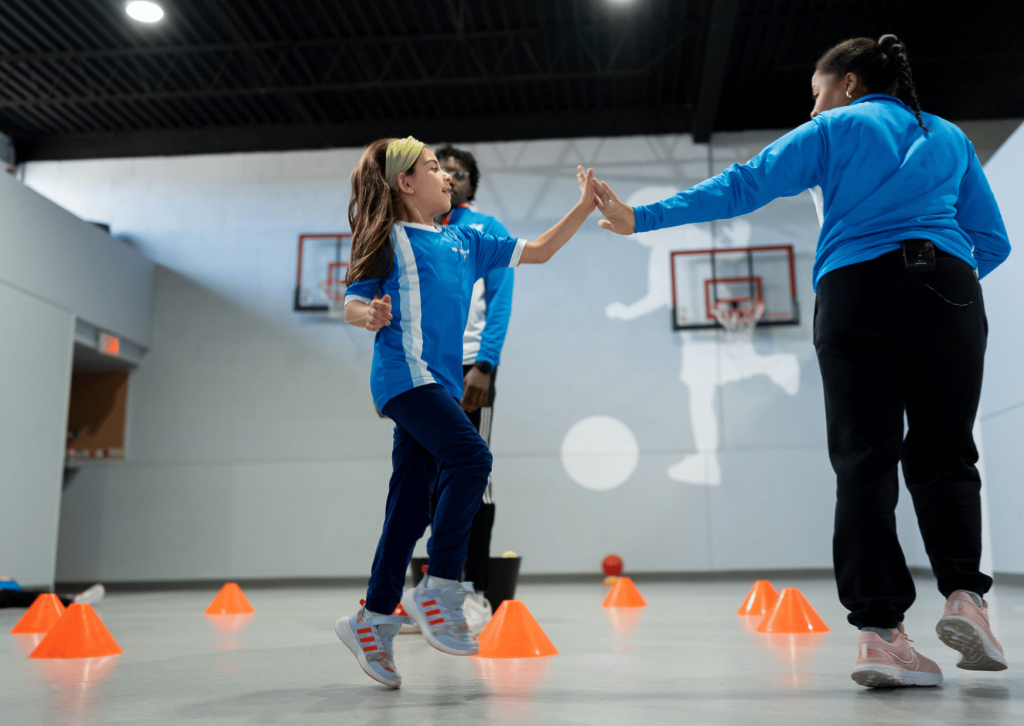
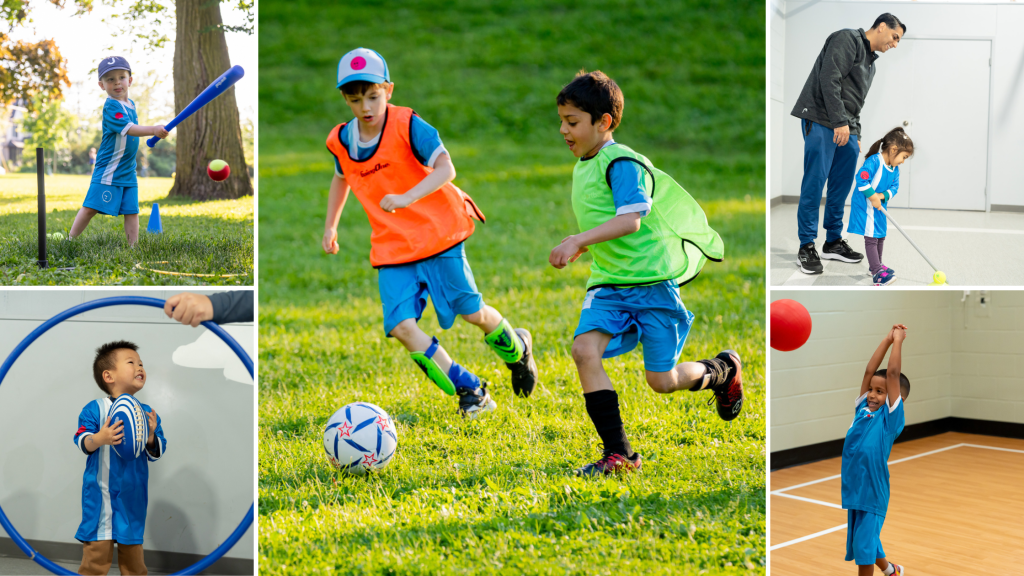
When kids are given an opportunity to succeed, they are more willing to put in the effort to learn and grow, so they can keep succeeding. That’s how we like to structure our multi-sport sessions, especially with the younger kids. We kick off with something easy and fun, like throwing around a bunch of colored balls and having the kids pick them up and toss them back in a bucket. It seems simple and maybe a little silly, but it’s deeper than that. It’s something that all of them can do, so everyone starts off with a high five and a feeling of accomplishment. Then, when we move onto a more difficult skill lesson, they’re riding on that confidence and know that the coach with the high fives has their back to support them through whatever they try next. While kids tend to only see the finish line as success, we like to celebrate wins in between start and finish with things as small as keeping both hands on the hockey stick. You can scaffold success and build in moments of victory before the finish line to show kids that there are multiple opportunities to be successful along the journey. It also helps to remove unnecessary barriers to their success. For example, we don’t start young kids with regulation-sized basketballs and net heights. We start with smaller balls and hula hoops, so they can be successful at a skill level that’s right for their size and be motivated to build up from there. Growth also begins with curiosity, so encourage that. Always give them a chance to try new ways to figure something out. It can be as simple as saying, “Let’s see what happens if we try this.” Giving something a try without knowing what the outcome will be helps build curiosity to stimulate that growth mindset.
How can parents balance providing support with allowing their children to experience and overcome difficulties on their own?
The idea is to support them enough to keep them safe, but not so much that you remove the challenge all together. Failure is a part of success, so rather than giving answers, parents can ask guiding questions that help children think through solutions themselves. This leads kids to ask the questions they need to be successful and helps them learn that they are capable of solving problems and navigating challenges.
What self-care practices would you recommend for parents to maintain their own resilience while going through the everyday challenges of raising children?
Parenting is demanding, and one of the best things parents can do for their children is take care of themselves. Simple self-care rituals like going for a walk, practicing mindfulness, exercising, deep breathing or even enjoying a quiet coffee can help recharge your emotional reserves. Give yourself permission to do something for yourself. Seeing that will model for your children how to self-regulate. Plus, if you want your child to be active, go out and be active yourself, whether that’s hitting the gym or playing sports with other adults. It’s also important to connect with other parents. Sharing experiences reminds us that we’re not alone in this journey. Perhaps most importantly, parents should extend the same compassion to themselves that they give their children. There is no such thing as a perfect parent. It’s in our right to pursue perfection, but attaining it is not our business. We try our best and learn along the way.
Ok. Here is the main question of our discussion. Can you please share “5 Strategies To Raise Children With Resilience and Emotional Strength”? If you can, kindly share a story or example for each.
1. Celebrate effort over outcome
At Sportball, we often have a child look up at us with that classic “I can’t do it” face. My response is always the same. I smile and say, “I love how hard you’re trying. That’s exactly what Kobe [or insert their favorite athlete] would do.” Their whole expression changes. They take a breath, give it another go, and even if the skill doesn’t click right away, they keep trying because they know the effort is what truly matters.
2. Create safe spaces for failure
In a multi-sport class, we were practicing overhand throws. One of my nine-year-olds missed the target completely and shouted, “I’m terrible at this.” Before the frustration could take over, I tossed my own ball and missed by a mile on purpose. The kids burst out laughing, and I shrugged and said, “Looks like I need practice too.” He tried again but this time smiling, and the rest of the group followed. Suddenly, missing wasn’t embarrassing; it was just part of the game.
3. Build confidence through small wins
Because children develop at their own pace, it’s important to recognize what “winning” looks like for each of them. In our Parent and Child classes and programs for 3–5-year-olds, sometimes “winning” is joining the group for the first time. Sometimes it’s holding the bat correctly or remembering a skill from last week. When we celebrate those small steps, kids start to see themselves as capable, and that confidence fuels everything that comes next.
4. Model calm, regulated behavior
When I’m giving instructions, and the group’s attention starts to drift, I use a class management strategy called the power of silence. Instead of raising my voice or giving a consequence, I simply pause mid-sentence and wait. The silence gets loud in the best way. One by one, the kids notice, settle and self-regulate. When everyone is with me again, I thank them and continue. It teaches them that calm is contagious, and that they can find it themselves.
5. Encourage problem solving and independence
In basketball classes, older kids often ask me to fix their form. After offering a few pointers, I’ll say, “Let’s try something. What do you think feels off?” They look down, adjust their stance, try again, and it’s almost always better. I’ll say, “See? You’re coaching yourself.” For the rest of class, they experiment, make adjustments and even help their peers. Their confidence grows because they realize they can self-correct and figure things out on their own.
How can mindfulness and emotional regulation techniques be incorporated into daily routines to support children’s emotional resilience?
I’ve actually taken some of the things from our adaptive programming at Sportball and integrated it into my home life. We do short breathing exercises before school or bedtime, and I like to do a lot of positive affirmations with my daughters before dropping them off at school. I’ll have them say “I am kind. I am strong. I am independent,” and I always say to them, “Be kind and make good choices.” The goal is for these repetitions and reminders to be stuck in their heads like a Bruno Mars song, so they always feel that they are their best, most confident selves. We also practice naming their emotions to help them better identify and communicate how they’re feeling, and sometimes we just take a pause. It’s OK to not always have the answer and to take a beat to self-regulate. Also, just model mindfulness yourself, so kids can see it in action. Movement is another powerful tool for releasing stress, anxiety and pent-up energy, especially with school-aged kids who sit in desks most of the day. Activities like sports, gymnastics and dance are great for that.
Are there any specific tools or resources (books, apps, courses) you recommend for individuals looking to improve in this area?
For kids, my obvious answer would be getting them into multi-sport youth programs that lead with fun over competition. Aside from the physical benefits, it’s an impactful way to teach kids valuable interpersonal skills, like following directions, taking turns and teamwork. Many parents also benefit from it too. They learn tools and strategies to help their children succeed and grow in a nurturing way. Any activity or class with parents and children can help build positive relationships with your kids. For parents, local parent groups on social media or through schools, hospitals or local organizations can be really beneficial communities of folks who have kids the same age and can share supportive resources. Sharing experiences and strategies helps parents see that they’re not alone. I recommend meeting up in person with other parents. Join an adult sports league, where you can enjoy the games and talk shop about parenting with others going through it. Hidden Opponent is a mental health organization that focuses on athletes, which is something I’m passionate about, and Sportball is very aligned with. It’s for athletes older than the ones we serve, but they provide really great resources for student athletes and their parents. It gives me hope to see other organizations prioritizing the emotional wellbeing of young athletes as they age and become the adults they’re meant to be.
Wonderful. We are nearly done. Is there a person in the world, or in the US, with whom you would like to have a private breakfast or lunch, and why? He or she might just see this, especially if we tag them. 🙂
The chance to connect with Dr. Becky Kennedy would be pretty cool, to talk about resilience, emotional regulation and how it helps transform kids. I think we’d have a lot to talk about on how to coach parents and coaches on how to interact with kids in a positive way. From the sports world, I’m a big basketball fan, so I have to say Steve Nash, because he’s a huge supporter of youth sports, and Steve Kerr because of his ability to coach. He won championships in his playing days, but he’s also won four for the Golden State Warriors. He gets the best out of his players who might not be the tallest or fastest, and it’s inspiring to watch.
How can our readers further follow your work online?
They can find me on LinkedIn and learn more at Sportball.com.
This was very meaningful, thank you so much. We wish you only continued success on your great work!
– Authority Mag Editorial Staff, Medium. Link to article: https://medium.com/authority-magazine/raising-resilient-kids-jason-drocha-of-sportball-on-strategies-for-nurturing-emotional-strength-ec33f6c709fb