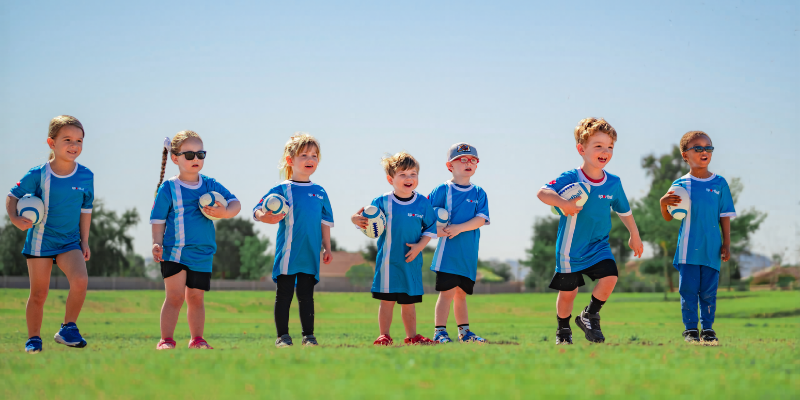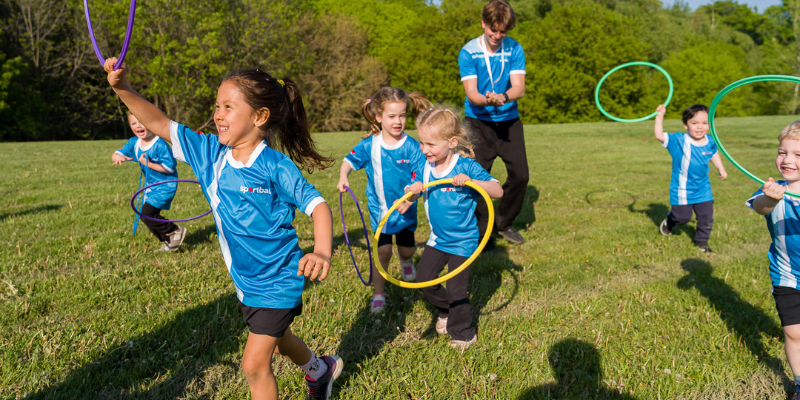
Walk into any park on a Saturday morning and you’ll see it: kids chasing soccer balls, swinging at T-balls, dribbling basketballs that look almost as big as they are. Sport is where a lot of childhood happens, and for good reason. Regular physical activity supports healthy growth, stronger bones and muscles, and better sleep, while organized sport adds something else: structure, teamwork, and a sense of belonging that’s hard to replicate anywhere else.
So when parents ask “what’s the best sport for my child,” the honest answer might surprise you: the sport itself matters less than you think. What matters far more is how the sport is taught, and whether the program is structured around your child’s age and stage of development. A well-run soccer class and a well-run tennis class will build the same foundational movement skills, the same confidence, and the same love of being active. The sport is the vehicle. The approach is what drives development.
This guide breaks down what to look for at every stage, from toddlers taking their first kicks to teens exploring competitive options, so you can make a confident, informed choice.
Understanding Sports Benefits for Children
Before comparing specific activities, it helps to understand why sport activities for kids matter so much in the first place.
Physical development: Sport builds fundamental movement skills: balance, coordination, strength, and cardiovascular fitness. Research on physical literacy shows that mastering these foundational skills early supports better long-term health and a more active lifestyle1.
Social and emotional growth: Team and group sports teach kids to communicate, share, win and lose gracefully, and work toward a common goal. These early lessons in Social skills often carry over directly into the classroom and friendships.
Cognitive benefits: Sport asks kids to think on their feet: reading the game, remembering rules, and adjusting strategy in real time. That kind of quick decision-making strengthens focus and problem-solving skills more broadly.
Lifelong habits: Children who enjoy being active early are more likely to stay active as adults1. A positive first experience with sport matters more than which specific sport it happens to be.
How to Choose the Right Sport for Your Child
With so many options, it’s worth slowing down before signing up for the first program you find. Rather than asking “which sport is best?” the better questions are:
Is it age-appropriate?
The program should be designed around what children at your child’s specific age and stage are developmentally ready for, not a scaled-down version of adult competition.
Does it prioritize fun and skill-building over winning?
At younger ages especially, the goal is to build a love of movement and sport. Programs that introduce pressure too early tend to burn kids out faster.
Does it encourage variety?
Exposure to multiple sports and movement patterns during childhood builds a broader athletic foundation than focusing on a single sport too soon.
Watch for readiness signs
Pediatric guidance notes that most kids develop the motor skills, attention span, and ability to grasp teamwork concepts needed for organized sport by around age six2. Before that, free play and simple skill-building activities are usually a better fit than a structured league.
Best Sports for Ages 2–5
At this stage, the goal isn’t competition, it’s exposure. Toddlers and preschoolers are working on fundamental movement skills: running, jumping, kicking, throwing, and catching. The specific sport is almost irrelevant, what matters is that movement is joyful and varied.
Developmental milestones
Most two- and three-year-olds are still mastering basic balance and gross motor control. By four and five, kids typically have the coordination to kick a stationary ball, throw underhand, and follow very simple directions.
Recommended activities
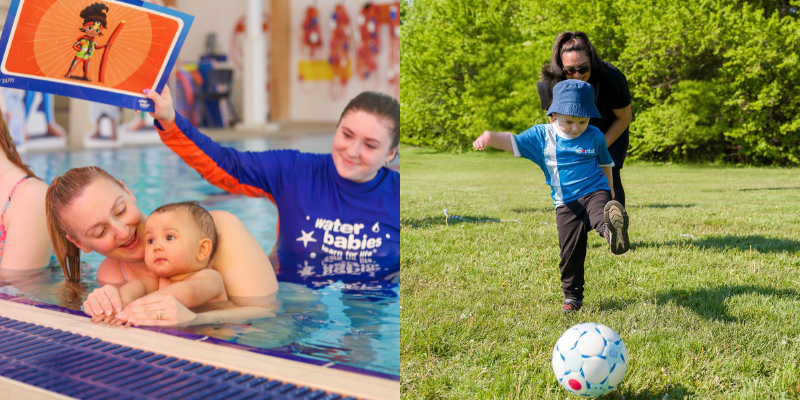
Multi-sport programs, introductory soccer, T-ball, and parent-and-child classes work well here. These low-pressure formats let kids explore different movements and build confidence without the structure or pressure of a competitive environment.
Structured vs. unstructured play
Both matter. Free play at the park builds creativity and confidence, while short, structured classes introduce kids to following a coach’s instructions and playing alongside peers, in small, manageable doses.
The parent’s role
Parental attitude shapes a child’s experience of sport at every age, but especially at this one. Cheering, participating alongside them, and keeping the mood light sets the tone for a lifetime love of movement. Sportball programs are built around exactly this kind of parent-and-child connection for the youngest age groups.
Best Sports for Ages 5–8
This is the heart of the sampling phase. Kids at this age are developing foundational movement patterns and beginning to understand the social side of sport, but they are not ready to specialize. The goal is variety, exploration, and fun.
The sampling mindset: If your child loves soccer, that’s great. Sign them up for soccer in the summer. But when fall comes around, try something different. Basketball, T-ball, gymnastics, swimming, a multi-sport program; the specific activity is less important than the variety of movements and experiences. Kids this age benefit enormously from building different skills across different sports.
Keep it non-competitive
Ages 5–8 is not the time for tryouts, travel teams, or year-round single-sport programs. Kids are still learning how to play, how to follow rules, how to win and lose. Removing the pressure and keeping the focus on learning and fun is what keeps them coming back.
Fundamental skills first
Whatever sport your child tries, look for coaches focused on basics: running mechanics, catching, throwing, kicking, balance, and simple teamwork. These movement fundamentals transfer across every sport they’ll ever play.
Setting expectations
Skill development at this age is uneven and that’s completely normal. One child might be kicking confidently while another is still figuring out which foot to use. The priority is consistent participation and enjoyment, not performance.
Best Sports for Ages 9–12
By nine or ten, kids often have a clearer sense of what they enjoy. Programs introduce more structure and skill progression, and some children may naturally gravitate toward one or two favourites. This is fine, but multi-sport participation should still be the norm.
Still sampling, not specializing
The American Academy of Pediatrics recommends that kids continue sampling more than one sport rather than specializing in a single one until at least puberty, noting that sport sampling promotes enjoyment while reducing injuries, stress, and burnout3. Specialization before age 12 is associated with higher rates of overuse injury and dropout.
Team sports and individual sports
Soccer, basketball, baseball, hockey, and volleyball offer teamwork and strategy. Swimming, tennis, gymnastics, and track give kids who prefer individual challenge a way to build skill at their own pace. Trying both types is valuable.
Preventing burnout
Watch for signs of fatigue, dread before practice, or declining enjoyment. If a child who once loved a sport starts dreading it, that’s a signal to reassess the schedule, the coaching approach, or whether it’s time to add variety.
Best Sports for Teens
Adolescence is when some kids start to narrow their focus intentionally, but even here, the approach and environment matter more than the specific sport.
Competitive considerations
Teens drawn to competitive leagues should be physically and emotionally ready for the higher intensity, including more demanding practice schedules and the pressure of tryouts or cuts.
Cost and commitment
Club and travel teams can mean a significant jump in time and expense. It’s worth weighing that against your teen’s genuine enjoyment and long-term goals before committing to a full season.
Long-term pathways
Some sports, like swimming, tennis, golf, or track, offer lifelong recreational value well beyond organized competition, making them a strong choice for teens who want to stay active without necessarily playing on a competitive team.
Considering college paths
For teens interested in playing in college, sports with established recruiting pipelines may offer clearer next steps, though academics and overall well-being should always come first.
Supporting Your Child’s Sports Journey
Whatever sport your child chooses, your support shapes how they experience it.
Keep it positive
Praise effort and improvement over outcomes. Research on parental involvement in youth sport found that supportive, emotionally engaged parents, rather than outcome-focused ones, are linked to children staying in sport longer and enjoying it more4.
Handle setbacks well
Losses, benched games, and missed shots are part of sport. How you respond after a hard day often matters more to your child’s long-term relationship with sport than the result itself.
Know when to switch
If your child has lost interest, dreads practice, or simply hasn’t connected with a sport after a fair trial, it’s okay to try something new. Finding the right fit sometimes takes a few tries.
Keep the fun in it
At every age, enjoyment is the strongest predictor of whether a child sticks with sport. Programs that prioritize fun alongside skill-building tend to keep kids engaged longer than ones focused purely on competition.
Getting Started with Sportball
The best sport for your child is the one they enjoy, in a program that’s built around how kids at their age actually learn and develop. That means age-appropriate curriculum, coaches who prioritize skill and fun over wins, and plenty of variety to keep things interesting.
Ready to help your child find their sport? Explore Sportball programs near you and book a trial class to see the difference a developmentally appropriate, play-first approach makes.
References
1 Fundamental Movement/Motor Skills as an Important Component of Physical Literacy and Bridge to Physical Activity: A Scoping Review. (2024). pmc.ncbi.nlm.nih.gov/articles/PMC12564026
2 American Academy of Pediatrics. Is Your Child Ready for Sports? HealthyChildren.org. healthychildren.org/…/Is-Your-Child-Ready-for-Sports.aspx
3 American Academy of Pediatrics. (2019). Organized Sports for Children, Preadolescents, and Adolescents. Pediatrics, 143(6). publications.aap.org/pediatrics/article/143/6/e20190997
4 A Qualitative Study Examining Parental Involvement in Youth Sports over a One-Year Intervention Program. (2019). pmc.ncbi.nlm.nih.gov/articles/PMC6801468